
A roof that stays dry through ordinary drizzle, then drips onto the landing every time a proper storm comes in off the Atlantic, is the most common call we get between October and March. It is also the one people put off longest, because by the time the weather clears the stain has dried and the problem seems to have gone away.
It has not. A roof leaking in heavy rain has a small opening that only gets enough water to matter when the rain is heavy, wind-driven, or both. Every storm wets the timber and insulation a little more, and a repair that would have been a morning’s work in October can be battens, felt and a new ceiling by spring.
Here is what to do when it happens, why roofs leak only in heavy rain, and where to look first.
What to do while it is still raining
- Catch the water and protect what is underneath. Buckets, towels, and move furniture and anything electrical out of the way.
- Keep away from wet light fittings. If water is coming through near a ceiling light or a switch, turn that circuit off at the fuse board and leave it off until an electrician has looked at it.
- Watch the ceiling. Plasterboard holding water will sag and can come down. Keep people out from under a bulge.
- Look in the attic if you can get up safely. With a torch, find where the water is actually landing, put a container under it and take a photo. That one photo saves a lot of time later.
- Note the conditions. The time, how heavy the rain was, and which way the wind was blowing. Wind direction is often the biggest clue we get.
- Stay off the roof. Wet slate and tile are lethal, and nobody should be up a ladder in a storm. Temporary covers are a job for a roofer with proper access.
If you plan to claim on home insurance, ring your insurer early. Policies often treat sudden storm damage differently from gradual wear, so photos taken on the day and a roofer’s written report afterwards both matter.
Why a roof only leaks in heavy rain
A sound roof sheds water by gravity. Each slate or tile laps over the one below, and the junctions are covered with lead or flashing so water runs past them. In light rain a small defect gets a small amount of water, which the underlay or the timber soaks up and dries out before anyone notices. Heavy rain changes three things.
- Volume. Gutters, valleys and the back gutters behind chimneys suddenly carry far more water than usual. If a valley is narrow, an outlet is blocked or a back gutter is silted up, water backs up, spills over the edge of the lead and runs under the covering.
- Wind. In the south west, rain rarely falls straight down. Driven rain is pushed sideways and even uphill, under the laps of slates and tiles, through gaps in ridge and verge mortar, and behind flashings that are perfectly adequate when the weather is calm.
- Duration. A long storm saturates everything. Old felt that has sagged between rafters holds a pool of water, cracked mortar soaks through, and a pinhole in a flat roof that would survive a shower keeps feeding the deck for hours.
That is why the most useful question we ask on the phone is not where the stain is, but whether it was windy, and from which side.
The usual culprits
Flashings and lead at junctions
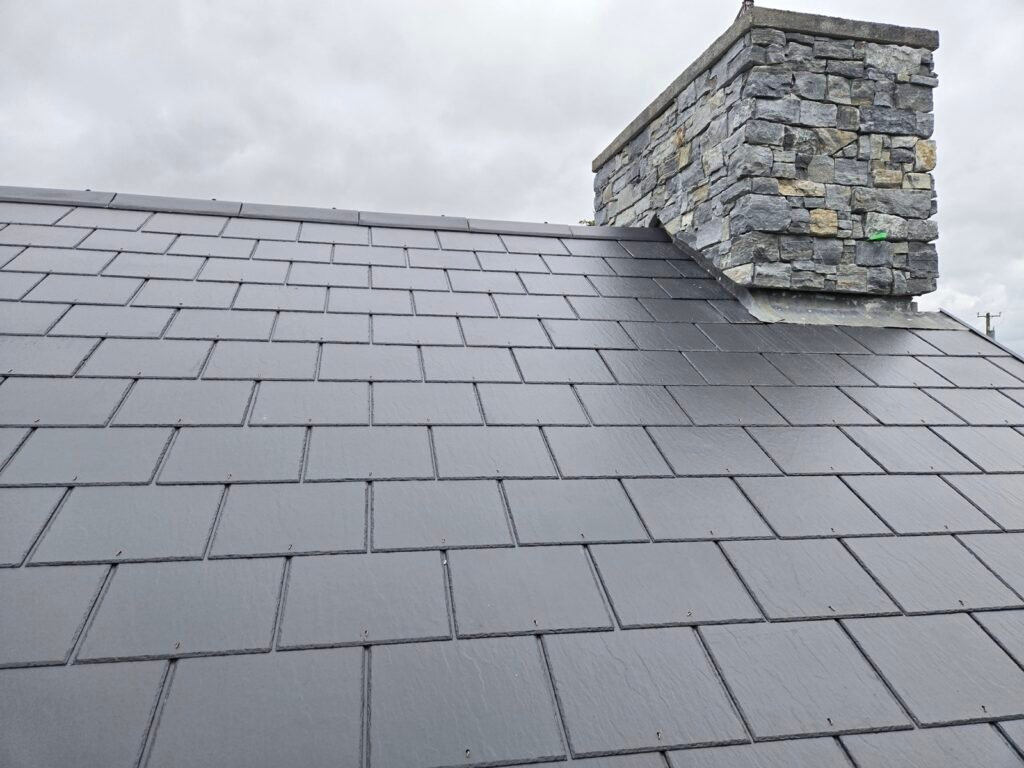
Where the roof meets a chimney, a wall, a dormer cheek or another slope, it depends on lead or a flashing to stay dry. Lead that is split, lifted by wind, too short in its upstand, or held in a chase whose mortar has cracked out will let in driven rain long before it lets in drizzle. Our guide to lead flashing on Irish roofs goes through each detail and how it fails.
Chimneys
A chimney takes weather on every side. Open pointing, cracked flaunching around the pots, and a back gutter that fills in a downpour are all classic heavy-rain leaks. An open pot on a fireplace nobody uses lets rain straight down the flue, which usually shows as damp on the chimney breast rather than a drip from the ceiling. See chimney repair and chimney capping.
Valleys
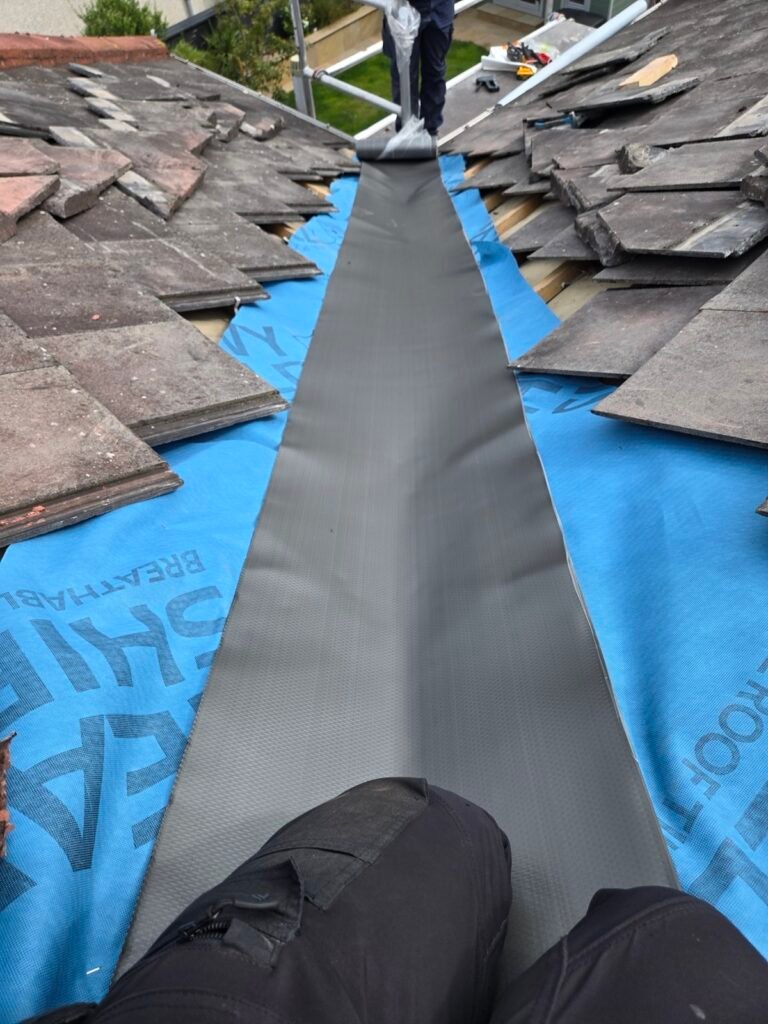
A valley collects the water from two slopes, so in heavy rain it carries more than any other part of the roof. A valley cut too narrow, lead that has split along its length, or moss and leaves holding water back will spill it sideways under the slates.
Ridge, hip and verge mortar
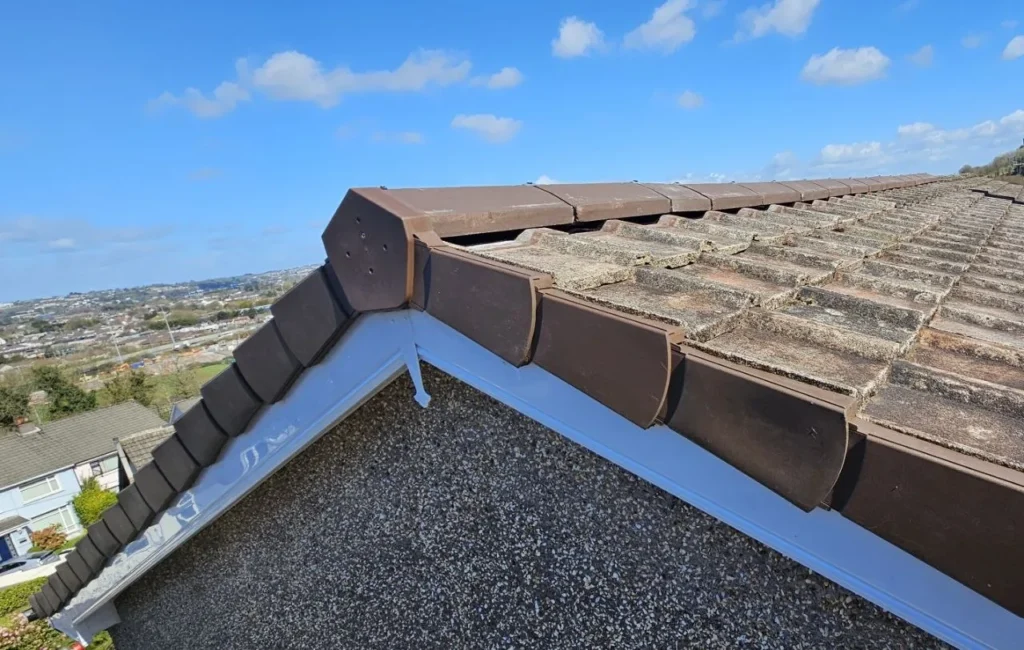
Bedded ridge and verge tiles rely on mortar that cracks and drops out over the years. In calm rain it hardly matters. In wind-driven rain the gaps send water straight onto the underlay or the top of the gable wall. Dry-fixed ridge and verge systems avoid the problem, and we often fit them as part of a roof repair.
Slipped or cracked slates and tiles
One slipped slate opens a channel that light rain mostly runs past and heavy rain does not. On older slate roofs the nails rust through over time, so one slipped slate is often the first of several.
Gutters and downpipes
An overflowing gutter is not a roof leak, but from inside it looks like one. Water pouring over the back of a blocked gutter runs behind the fascia into the wall head and shows at the top of an external wall. Clearing it is cheap. Leaving it rots the fascia and soaks the wall. See gutters and fascia.
Flat roofs and skylights
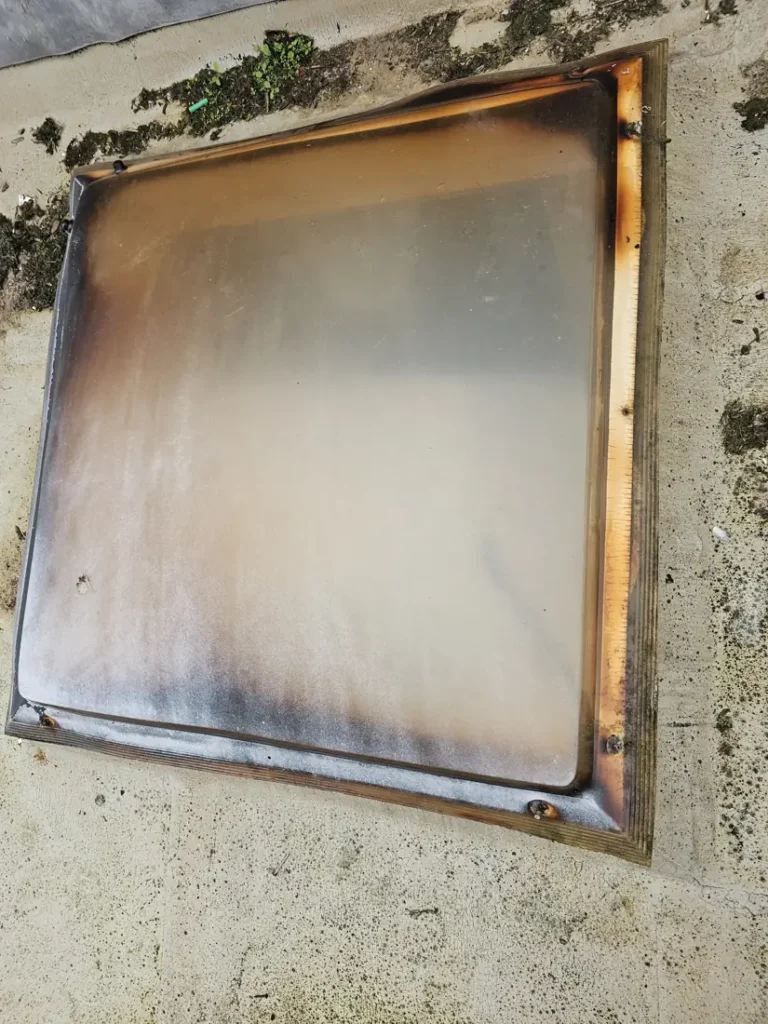
Flat roofs leak where water sits. A slight dip, a lifted joint, or a crack in a fibreglass roof at the edge trim only shows when the roof holds a puddle long enough to find it. Old plastic rooflight domes go brittle, crack and leak at their fixings, especially in wind. See fibreglass flat roof repair and skylight replacement, and for budgets, our flat roof repair cost guide.
Failed underlay
Old bitumen felt goes brittle and tears at the eaves, where it is exposed to sun and wind. Once it has gone, the slates or tiles are the only line of defence, and they were never meant to be fully watertight on their own in driven rain. If the felt has failed across the roof, patching single slates will not hold, and it is time to talk about re-roofing.
Where the water shows is rarely where it gets in
Water that gets past the covering runs down the underlay or along a rafter or batten until it finds a low point, then drops. A stain in the middle of a bedroom ceiling can start a metre or two upslope, sometimes on the far side of a wall. That is why replacing the slate directly above the stain so often achieves nothing.
The patterns we see most often:
| Where you see it | Most likely cause |
|---|---|
| Damp patch on the chimney breast | Flaunching, pointing, an open pot, or the back gutter behind the stack |
| Top of an external wall, inside | Blocked or overflowing gutter, or driven rain at the eaves |
| Along a gable wall | Verge mortar, or a gap where the roof meets the gable |
| Under a valley or where two roofs meet | Valley lead, or a narrow valley overflowing |
| Around a roof window | The flashing kit, or the lead and slate detail around it |
| Extension ceiling under a flat roof | Ponding water, a failed joint or edge trim, or the skylight |
| Only when the wind is from one direction | A flashing, verge or ridge detail on that side of the roof |
Leak or condensation?
Not every wet patch in cold weather is the roof. Condensation forms when warm, damp air from the house meets a cold roof space with poor ventilation. It is probably condensation rather than a leak if:
- there are droplets on the underside of the felt or on nail tips across a wide area, not one wet spot
- it appears on cold, still nights rather than in storms
- there is black mould on the rafters and the underside of the roof boards
- the insulation has been pushed hard into the eaves, blocking the airflow
The fix is ventilation, not slates. It often appears after insulation is upgraded without keeping the eaves clear, which is why we fit roof insulation with the vents in mind.
Repair or replace?
Most heavy-rain leaks are local and are fixed in one visit: a flashing re-dressed, a valley re-laid, a run of slates replaced, ridge and verge re-bedded or dry-fixed. That is the right answer for most roofs.
Replacement starts to make sense when the leaks keep moving around the roof, the felt has perished across a whole slope, slates are coming off their nails in numbers, or the battens are soft. At that point you are paying for access every winter to chase the next leak. Our roof replacement cost guide covers what a full re-roof costs in 2026 and when a repair is still the better call.
How we find a heavy-rain leak
On a roof leak call-out we start in the attic, not on the roof. Water marks on the timber show the path back to where it got in. Then we go up and check every detail on that line: flashings, valleys, ridge and verge, slates and the chimney. Where it is not obvious, we wet test sections of the roof with a hose, starting low and working up, until the drip appears inside.
You get photos of what we found and a written price to fix the cause, not the stain. Where we can, we make it watertight the same day.
Roof leaking in heavy rain: questions we get asked
Why does my roof only leak when it is windy?
Wind drives rain sideways and upwards, under the laps of slates and tiles and behind flashings and verge mortar that keep out rain falling straight down. A leak that only appears with wind from one direction almost always points to a junction or edge detail on that side of the roof.
Can a roof leak be fixed while it is still raining?
A temporary cover can go on in bad weather if it is safe to get up, but lead work, mortar and flat roof repairs need a dry spell to be done properly. The priority in the rain is to protect the inside of the house and find where the water is landing in the attic.
Will home insurance cover a roof leaking in heavy rain?
It depends on your policy and the cause. Sudden storm damage, such as slates blown off, is often treated differently from gradual wear like old felt or perished mortar. Take photos on the day and ask your insurer what report they need from the roofer.
How long can I leave a leak before getting it fixed?
Not long. Every storm wets the battens, insulation and ceiling a bit more, and wet timber rots. A leak caught early is usually a small repair. Left over a winter, it can mean new battens, felt and plasterboard as well.
Is it worth getting the roof checked before winter?
Yes. An autumn check with the gutters and valleys cleared catches slipped slates, cracked mortar and blocked outlets before the storms find them, and it costs far less than repairing water damage inside.
Water coming in?
Ring 085 220 1422 or send a photo of the stain and the address on WhatsApp. We cover Kerry, Cork and Limerick, with a free survey, a written fixed price and a written guarantee on our work. Or get in touch here.